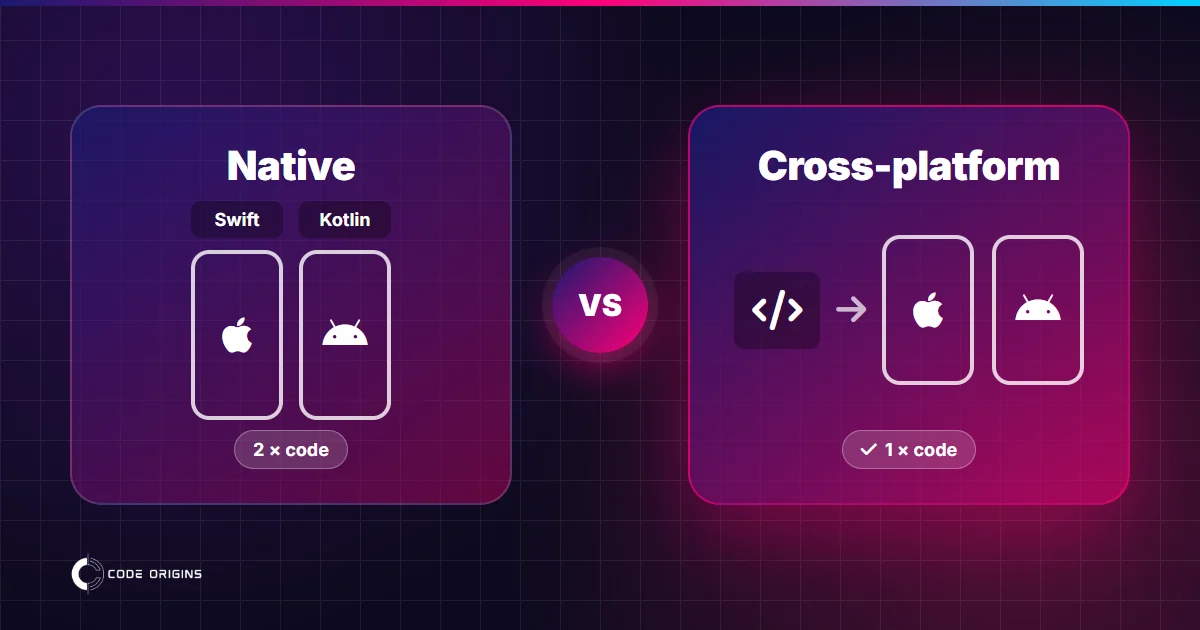
For most business apps a cross-platform approach (React Native or Flutter) is the best choice: one codebase gives you both iOS and Android apps, at a much lower cost and in less time. Choose native (Swift for iOS, Kotlin for Android) when the app makes deep use of the device or needs maximum performance, for example games or heavy video processing.
| Criterion | Native (Swift / Kotlin) | Cross-platform (React Native / Flutter) |
|---|---|---|
| Codebase | Two separate ones: iOS and Android | One shared |
| Cost | Higher | Lower |
| Delivery time | Longer | Shorter |
| Performance | Maximum | Almost the same for business apps |
| Device features | Fully available | Most are available, the rest through native modules |
| Updates and support | Twice the work | Once, for both platforms |
When to choose cross-platform
- Online shop, orders, accounting, chat, notifications, personal account.
- You need to launch on the App Store and Google Play at the same time.
- You want to test an idea faster.
When to choose native
- Games, AR, complex video or audio processing.
- The app will run on only one platform.
- There are strict battery and speed requirements.
From our experience
We built ProMobile and BonPharm with React Native, from one codebase for iOS and Android. More than 200 employees work in ProMobile every day, and the app has real-time chat and notifications.
From our work
Full portfolio


Have a project?
We will tell you which technology fits your project and estimate the timeline and cost.