Mobile App Development
iOS and Android apps taken from idea to a published product.
CodeOrigins has been building mobile apps for Armenian and international businesses since 2022. We work both natively, in Swift and Kotlin, and cross-platform, in Flutter and React Native, and we choose the technology based on your problem, budget and deadline rather than on what is convenient for us.
We do not hand over a file, we hand over a working product: published on the App Store and Google Play, with analytics and crash monitoring already wired in. You also get the admin panel that controls the content inside the app.
Native or cross-platform: how to choose
If your app leans heavily on the device itself, camera processing, Bluetooth peripherals, background execution, heavy animation or AR, then native development in Swift for iOS and Kotlin for Android is the right call. If the app is mostly business logic, lists, profiles, payments and API traffic, cross-platform with Flutter or React Native gets you the same result in noticeably less time because most of the code is shared between the two platforms. After the brief we always put in writing which route we recommend and the reasoning behind it, including what you give up either way.
The apps we build
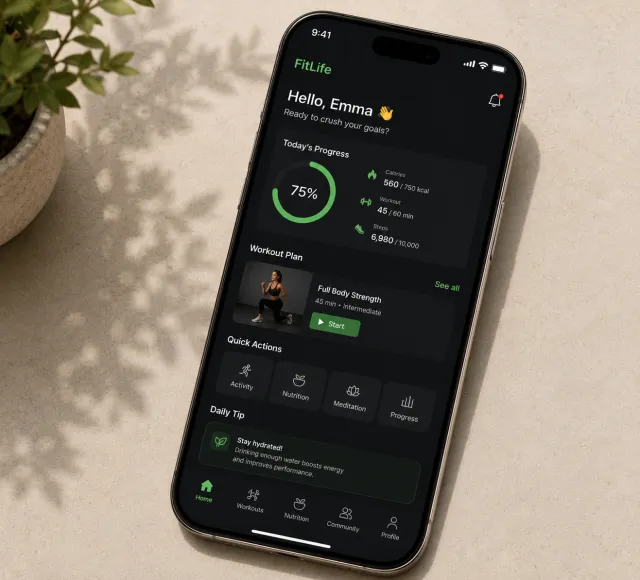
Delivery and ordering apps with maps, courier tracking and online payment. Fintech and banking products with two-factor authentication and secure storage. Loyalty programmes with QR scanning and push campaigns. Internal corporate apps for field staff, warehouses and sales teams. Education and fitness apps built around subscriptions. Marketplaces with separate buyer and seller interfaces. In almost every case we start with an MVP so you can test demand before committing the full budget, then extend the same codebase rather than rebuilding it.
Timelines and what is included
A lean MVP is usually ready in 6–8 weeks, a mid-complexity business app in 10–14 weeks, a marketplace or fintech product in 16–20 weeks. Timeline and price are both fixed in the contract. The scope covers UX prototyping, UI design for both platforms, app engineering, backend and API, an admin panel, testing on real devices, publishing to both stores and a 12-month technical warranty. Design follows Apple Human Interface Guidelines and Material Design so the app does not run into avoidable review rejections.
Backend, integrations and life after launch
Half of any app is the part users never see. We build backends on Laravel with MySQL or PostgreSQL, and handle push notifications through Firebase. We integrate payment providers, SMS and OTP services, maps, CRMs and your accounting system. At launch we switch on Crashlytics and product analytics so you can see where users actually drop off instead of guessing. Defects in the first year are fixed under warranty, and new feature releases run through a monthly support plan with a predictable release cadence.
How we work
Brief and technology choice
We go through the idea, the user scenarios and the budget, then recommend native or cross-platform in writing with the trade-offs spelled out.
UX and UI design
We build the screen map and a clickable prototype, then the visual design for both iOS and Android.
Engineering and backend
The app is written in two-week sprints. At the end of each sprint you get a test build you can install on your own phone.
QA and publishing
We test on real devices, then prepare App Store Connect and Google Play Console listings and shepherd the app through review.
Technology
- Swift
- Kotlin
- Flutter
- React Native
- Laravel
- Firebase
- PostgreSQL
- REST API
Selected work
Frequently Asked Questions
How long does it take to build a mobile app?
An MVP takes 6–8 weeks, a mid-complexity business app 10–14 weeks, and a marketplace or fintech product 16–20 weeks. Those figures include design, engineering, testing on real devices and publishing to both the App Store and Google Play.
Should I choose native or cross-platform?
It depends on the app. Choose native when you need deep device integration: heavy graphics, background processing, AR or specialised hardware. For apps driven by business logic and APIs, cross-platform delivers the same result faster. We give you a written recommendation after the brief.
Do you publish the app to the stores?
Yes. We set up App Store Connect and Google Play Console, prepare screenshots and descriptions, complete the privacy questionnaires and stay with the app through review until it is approved. The developer accounts are registered in your company name and remain yours.
I already have a website. Can the app use the same data?
Yes, provided the site has an API or one can be added. The app and the site then share a single database, so products, orders and user accounts stay in sync automatically. If the API does not exist yet, we build it as part of the project.
Who owns the code?
You do. Source code, design files and all account credentials are transferred at handover and this is fixed in the contract. You are free to continue development with any team afterwards, with no lock-in to us.
What happens after launch?
You get a 12-month technical warranty and we fix defects at our own cost. Alongside it we offer a monthly support plan covering adaptation to new iOS and Android releases, store policy changes and the development of new features.
This service by region
Other services
- Website Development
- iOS App Development
- Android App Development
- React Native Development
- Flutter Development
- E-commerce Development
- Custom Software Development
- UI/UX Design
- Web Application Development
- SaaS Development
- Backend Development
- API Integrations
- Maintenance and Support
- Website Programmer
- Mobile App Programmer
- Freelance Developer
- Hire Software Developers
- Software Development Company
- IT Outsourcing & Outstaffing
- SEO Services
- Outsourcing to Armenia
Request a quote
codeorigins.info@gmail.com | +374 94 14 90 60
Request a quote